Friday, April 29, 2011

"All About Eve" (1950)


One of the greatest showbiz dramas out there. it still applies to this day; like "Network". we have our diva, protege, critic and the new girl. a damn good recipie for disaster. the film has a fantastic screenpley but it's all about execution from there. it deliverd. the pot is brewing from the first scene where Anne Baxter, who plays Eve, is accepting the highest honor for stage acting. we hear a wonderful voiceover by Addison the critc played excellently by George Sanders who won the Oscar. he looks prodly at Eve whilest Bette Davis and Celest Holm give her a composed but devilish look. we are hooked. this is the genious of the film. it's deliverence. the order in which its presented, the acting and its approach are all so pristine. it's smart and keeps our attention- and its one of the few pictures in which we actually feel bad for Bette Davis.


So we have our diva, Margo Channing, played by Bette Davis. she's loved by everyone. people pay through the nose to see one of her performances. there is the famed director Bill Simpson played by Gary Merrill and his writer Lloyd Richards (Hugh Marlow) and his wife Karen (Celeste Holm). and then the critic Addison but i've already introduced him. Anne Baxter plays Eve who is obsessd with Margo. she has been to every one of her performances and travels wherever the play goes. One day, she finds Karen while waiting in an alley after one of the shows and insists, but politely, on meeting Margo. She agrees and says that Margo would love to meet her. Eve is brought into Margo's dressing room and after being subtly joked at shares her incredibly sad story. everyone falls in love with her and her sweet personality. Eve eventually intigrates herself as Margo's personal assistent, doing her mail, shopping for her and becomes a close friend discusing men and fasion. Eve also begins hinting her aspiration to be an actress herself. she set's up a birthday party for Bill without Margo's knowledge. Margo is secretly inlove with Bill thus complicating the plot when Eve seems to be fliritng with him. Margo become fed up with Eve but everyone around loves her and her kindness. and that is the problem. what happens in showbiz then happens now. no matter what the time is it happens. i love when older films apply to todays world. it may not even be in showbiz but in our government it happens to much. even at our schools; the topic has been done time after time.


I remeber when i first saw the film, i thought Bette Davis played Eve because she was always on the cover with Anne Baxter in the background somewhere (curious, isnt it?). it is interesting how Margo is the one torn down but the real actress who plays Margo trumps Anne Baxter who's character is in the title. it takes skill to be an actor in the entertainment world. you have to be careful who you let in ("Låt den rätte komma in"). you never know, they may end up destroying you. i love how the film so expertly exploits that about our society. how we are the top one minute and a nobody the next. Bette Davis was phenominal. she was exactly who the character needed to be: snotty, uppity, and then in the end we feel bad for her. Baxter was alright. both women recieved an Oscar nomination for Best Actress but niether won. Baxter felt to nice to do the things she did. that's why i did not expect what happend. her face just reflects kindness and gentlness which was good for the first half of the film. all of the other actors were excellent too. Oh and yes, i forgot to mention Marylin Monroe was in the film. she had very small part but got a lot of recognition for it. i love this film in all respects. one of the greatest screenplays next to "Casablanca", "Citizen Kane" and so on. The film really makes us think about our leaders today: what did they do to get to the position they are in know?


Academy Awards, USA
YearResultAwardCategory/Recipient(s)
1951 WonOscarBest Actor in a Supporting Role
George Sanders
Best Costume Design, Black-and-White
Edith Head
Charles Le Maire
Best Director
Joseph L. Mankiewicz
Best Picture
(20th Century Fox).
Best Sound, Recording
(20th Century-Fox Sound Dept.).
Best Writing, Screenplay
Joseph L. Mankiewicz
NominatedOscarBest Actress in a Leading Role
Anne Baxter
Best Actress in a Leading Role
Bette Davis
Best Actress in a Supporting Role
Celeste Holm
Best Actress in a Supporting Role
Thelma Ritter
Best Art Direction-Set Decoration, Black-and-White
Lyle R. Wheeler
George W. Davis
Thomas Little
Walter M. Scott
Best Cinematography, Black-and-White
Milton R. Krasner
Best Film Editing
Barbara McLean
Best Music, Scoring of a Dramatic or Comedy Picture
Alfred Newman

Thursday, April 28, 2011

"Vera Drake" (2004)


Imelda Staunton and Philip Davis in one of the many heart-wrenching scenes.

This as not an easy film to watch. there were many troublng scenes in which i wanted to help the characters. thatis the effect director Mike Leigh wants and acheives. it is a controversial subject, abortion, which needs to be delt with in the most careful manor. we see a cozy British family in the 1950s torn by the crime thier mother has been commiting for over 20 years. we feel that she justifies what she has done because of her reason behind it. the perfromances were brilliant especially that of Imelda Staunton who played Drake. it was facinating watching her performance. this is a very unique subject and i love the seemingly careless way it was handled. they did not make a huge deal about it; it just happened.

We see Vera Drake. the sweetest little plum of  woman with a "heart of diamond". she goes around cleaning houses, visiting elders and making them tea. everyone loves her. her son tailors suits, her daughter is as painfully shy as Laura in "The Glass Menagerie" and works as a lightbulb checker and the husband fixes automobiles. her whole family loves her dearly. she is a sincere and genuine mother and wife; and criminal. we see she has another job; helping girls. she does it once or twice a week for many years without her family knowing. she uses some soap, warm water, disinfectant and a rubber syringe. with her sweet and loving voice, she is able to calm the young women if in distress. a parallel story shows the daughter of an aristocrat that Staunton works for who was raped by her boyfriend. she gets a legal abortion and we are shown how that works. this young women is played wonderfully by Sally Hawkins. The daughter of Staunton gets engaged to another shy man that Staunton invited over a few times out of the goodness of her heart. they eventually become engaged. Then something happens. One of the girls she does gets a serious infection and nearly dies which acording to Stauton, never happens. after the girl has been saved, the mother is forced by the doctors to go to the police. there is a knock on the door. the family, including the husband's brother and sister in law are having a party in celebration of the new engagement and the pregnancy of the sister in law. the police are at the door taking Staunton under arrest. from that moment on Stauntons warm and assuring expresion is replaced by a resentful gaze of sorrow (seen in the picture below). the family is in disbelief and are positive it's a mistake; after all, she's a saint. but the find out through some of the most grueling and painful interrogation and coutroom sequences i have ever expirienced. they cant believe she has done this. the husband forgives her for the best reason: she did these acts out of the "goodness of her heart"-she didn't even take money.
That to me is the most frustrating thing. she did this to help people- not to cause any harm. she treated everyone with respect and when the police came, she fessed up completely and caused no trouble. she was so shocked that someone almost died because of her that she could hardly speak-just cry. her son could not forgive her because he would hear about it in the paper but never thought it was someone in thier own house. one of the greatest things about the film is Staunton's performance which did deserve the Oscar over Hilary Swank's for "Millin Dollar Baby". swank was good, but not THIS good. we felt for Vera. If only the judge knew what kind of person she was, maybe she would not be in as severe situation as she is now. The last line of the film has no importance. it's the last shot that is incredibly powerful. it shows the family, without Vera, sitting around the table without a sound; still in disbelief and shock about the prior events.


Academy Awards, USA
YearResultAwardCategory/Recipient(s)
2005 NominatedOscarBest Achievement in Directing
Mike Leigh
Best Performance by an Actress in a Leading Role
Imelda Staunton
Best Writing, Original Screenplay
Mike Leigh

Wednesday, April 27, 2011

"Double Indemnity" (1944)


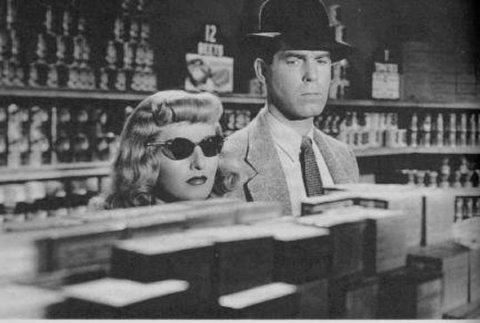
Barbara Stanwyck, Fred MacMurray and Edward G. Robinson
in one of the many famous scenes.

This was my second Billy Wilder film that i saw after "Some Like it Hot" from 1959. I expected something incredible and chilling. that's exactly what i got. just from it's opening sequence and i'm not talking about the car scene, but the scene with a silhouette image of Fred MacMurray on crutches, i knew we were all in for a bumpy night. i love film-noir and Welles, Lang and yes Wilder are all masters of that. we can see how this film influenced our filmmaking today. this is what we call neo-noir, a modern version which, of course is not as good as the original. the film is incredibly chilling. it is so well written, it's hard not to be. the film was based off of a novel that was a bit different including a competly altered, but perfect ending. the performances are wildly haunting. especially that of Stanwyck who earned an Oscar nomination. i loved it's style and it's movement. it was sleak, cool and smart. like a Bond film with a larger brain size.

The first scene is inserted to hook the audience in. it was very similar to a later film of Wilder's "Some Like it Hot". we see a man furriously trying to get somewhere in his car. he finally gets to an office building that we can assume is his workplace. he gets to a recording machine in his office and says, "Dear Keyes, I suppose you'll call this a confession when you hear it... Well, I don't like the word confession, I just want to set you right about something you couldn't see because it was smack up against your nose...you said it wasn't an accident, check. You said it wasn't suicide, check. You said it was murder... check." we have been hooked. the film is told in flashback and then to a circular ending. we have an insurance rep, MacMurray, who comes up to a clients house to find the husband gone, but the seductive wife. this is Stanwyck's part. she incessently asks about accident insurace but her stirring glare blinds MacMurray completly. then he gets the picture: she wants to take out an accident policy to kill her husband, make it look like an accident and get money out of it. he is offended but he keeps thinking of it, and her. after several meetings, they strike up an affair and finally, MacMurray is in. they devise a highly structured plan. it seems good because they have a knowledgable insurance rep on the inside and a seductive woman on the outside. both have very little hunches and the plan begins. they are going to kill him on a train (not exactly but i dont want to give spoilers) and get double pay because he died on the train: thu the title, Double Indemnity. this is such an incredible plan and i dont want to give and plot details; just watch the damn thing.

What i love most about the film is its daring subject. a woman cheats on her husband and knocks him off all in the same period of time of Hitler in power and WWII. that's the point of film-noir. those raunchy violent films in times of depression and war. but it was still a hit with 7 Academy Award nominations. MacMurray's performance was not nominated becuase it was not that good. he was a bit too composed for the events taking place. he talked about being incredibly nervous and not "being able to feel his footsteps" but he really did not show it. Stanwyck was ingenious. she was so malicious but could play oppossum when she needed to. that devilish side of her is what got people's attention-a woman, acting like this. that's why it would have been so shocking which was the effect Wilder wanted. the way it was shot was the conventional shadowy, eerie and dark tone that is attributed to film-noir. if you look at Wilder's other masterpeice and a personal favorite of mine "Sunset Blvd.", it is shot almost identically (the same cinematogrpher, John F. Seitz for both films). the thrilling music was done by Oscar winner Miklós Rózsa which i have posted a video of the main theme. in Woody Allen's hilarious film "Manhattan Murder Mystery" there is a scene where the characters attend the film. this is so perfect becuse the Allen's film is somewhat of a spoof of Indemnity. below i have done another shot comparison to Roman Polanski's film-noir masterpeice "Chinatown" from 1974. I suggest this to any noir fan but if you are a noir fan, it goes without saying that you've seen this film.


                                      "Chinatown"


                                  "Double Indemnity"


Academy Awards, USA
YearResultAwardCategory/Recipient(s)
1945 NominatedOscarBest Actress in a Leading Role
Barbara Stanwyck
Best Cinematography, Black-and-White
John F. Seitz
Best Director
Billy Wilder
Best Music, Scoring of a Dramatic or Comedy Picture
Miklós Rózsa
Best Picture
(Paramount).
Best Sound, Recording
Loren L. Ryder (Paramount SSD)
Best Writing, Screenplay
Raymond Chandler
Billy Wilder

"The End of the Affair" (1999)


I saw this last night kowing that it was not incredibly critically acclaimed. it was not awful, but nothing good either. there were some good points such as the gorgeous cinematography, powerful performances (espicially Julianne Moore's), a moving score and costume design. the story was weak to begin with. i have not read the book so the book might be good, but the film made it seem very soap opera like. i did enjoy the intricate way in which the filmwas presented. it felt somewhat like "Atonement": out of order. that was an interesting touch. the film did feel like something out of the Hallmark chanel; especially the ending. the passion felt forced becuse it was thrust in our face too quickley. love at first sight is hard to buy.

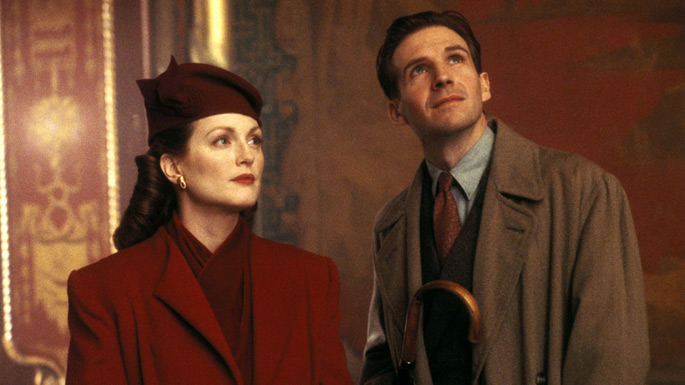
So we have a harried writer who is full of hate and jealousy; somewhat like "Moulin Rouge". he is starting his new novel about his previous affair with a married woman named Sarah played by Moore. she is bored with her current blase husband and highly seductive. Ralph Fiennes plays the writer who becomes infatuated with Moore. they have countless breakups and makeups that seem very out of place. it was almost silly. oh i love you, now i hate you. one loves the other while the other doesn't and vis versa over and over again. it was almost as if Neil Jordan, the director, was trying to buy time or make the film seem longer and more of a romantic epic (failed at that). the husband is slow and finally catches the drift when Fiennes insists on having a private investigtor put on Moore's watch. this is done for Fiennes himself not the husband. remember he is incredibly jealous one. he becomes obsessed with finding out if she is cheating on him. the husband finally comes to and gets that his wife is cheating on him with Fiennes. oh but he forgives him for the climactic reason. this is quite a silly film. the religious aspect was interesting. how Moore seeks God for help out of this mess she's put herself in. she begins performing small, but noticable miracles.

The film was nominated for two Academy Awards: Best Actress- Julianne Moore and Best Cinematography. both deserved nominations. Moore's performance was the usual spectacular. but her greatest performance was in "Far from Heaven". also her performance in "Magnolia" was incredibly powerful. Fiennes was good too. the score was beatiful and the main theme was played over and over again until it got stuck in your head. the cinematography was very old fasioned. it had that glow effect. the way the camera moved was spectacular especially in the opening sequence. but cinematograhy does not save the film. it felt like it was trying to be "The English Patient". lengthy, dramatic, steamy, passionate, and a tearjerker. well, it succeeded in few of those catagories. the climax was incredibly predictable with the first cough. it was the end of "Love Story" from 1970.  and the way it was presented was quite weak. this is not a stirring, passionate drama. The ending was too forced in this soapy melodrama of a picture.
Academy Awards, USA
YearResultAwardCategory/Recipient(s)
2000 NominatedOscarBest Actress in a Leading Role
Julianne Moore
Best Cinematography
Roger Pratt

Tuesday, April 26, 2011

"There Will Be Blood" (2007)


This is one of the greatest films of the past decade. the film is about business, business deals and business cons. we are presented a topic most of us don't know about except for maybe the documentary-goers and book readers (or if you lived at this time which i certainly did not). these are the times of oil. what people would do to get their hands on oil is what so would call disgusting; yeah well is happens everyday in our world. the film is directed by one of the greatet directors of our day: Paul Thomas Anderson. he wrote and directed one of the deeepest and humane films ever and one of my favorites: "Magnolia" in 1999. he is and incredibly skilled director who does not have one sole style. he deals with depression and isolation deftly; we can conclude that he has probably expirienced it first hand. We have the "oil man", Daniel Plainview played by Daniel-Day Lewis who i will get to in the second or third paragraph. he goes from town to town seeking oil deals. he is quite wealthy but he has worked for it. we see him as the actual mine worker getting his hands dirty, falling down and breaking bones. He has worked hard for the money and still does. but he is not a holy man. he has sinned. he cheats lies and bargains all for wealth. This all is challenged when he goes to a town in search of oil. This town is as about religious as you can get.

So Lewis is your orthodox buisness man. he has been in the business long enough to know the loop holes and knows how to get around people. he dextrously uses his son to convince people that he is a family man. his son H.W. is not he own son. a friend of his died in one of the mines so he took over. he gets a tip from a young man from a small town that there is a huge amount of oil that is seeping from the ground. but the young man is not stupid. Lewis, in large hopes for a breakthrough, travels with his son pretending to go quail hunting. they settle on  property with a deeply religious family primarily run by their teenage son. it was their other son who tipped Lewis about the oil in their property. Paul Dano plays both sons. once settled down, Lewis reveals the real reason why they are there: oil. of course he offers his deals but again, the family is not stupid. they, naturally, want a huge donation to their church seeing as how the whole town uses it. Drilling begins, and then Lewis's unknown brother shows up looking for some money, knowng og his brother success in the oil business. this presents problems as well. we recieve insight into the craft that is done so well. the score is eerie and showcases the emptiness of the people and their setting. most of Andersons's scores are incredibly suiting to the emotion and setting of his films.
Lewis's performance is one of the greatest of our time. he seems experienced and professional as the character is. it is a unique and complex character. he said he based his voice off of John Huston's which for me was very recognizable but perfect. Paul Dano is better than he was in "Little Miss Sunshine" which he was good in as well. he was really convincing as a radical religious leader in his town. Anderson pulls wonderful performances from his young actors like Jeremy Blackman's moving performance in "Magnolia". Dillon Freasier is no different. Lewis is the kind of actor that can be placed into any setting and adapt. like Blachett and Streep. he is not a type-cast actor like Michael Cera and Jesse Eisenberg. his wonderful performance in "My Left Foot" really shows his ability and Scorsese's "Gangs of New York" does as well. But i love his evil and cold side. Like Ian Holm in the heart-wrenching Atom Egoyan film "The Sweet Hereafter", Lewis is there for business, not pity. This is the genious of the film.


Academy Awards, USA
YearResultAwardCategory/Recipient(s)
2008 WonOscarBest Achievement in Cinematography
Robert Elswit
Best Performance by an Actor in a Leading Role
Daniel Day-Lewis
NominatedOscarBest Achievement in Art Direction
Jack Fisk (art director)
Jim Erickson (set decorator)
Best Achievement in Directing
Paul Thomas Anderson
Best Achievement in Editing
Dylan Tichenor
Best Achievement in Sound Editing
Matthew Wood
Christopher Scarabosio
Best Motion Picture of the Year
JoAnne Sellar
Paul Thomas Anderson
Daniel Lupi
Best Writing, Screenplay Based on Material Previously Produced or Published
Paul Thomas Anderson

"Det Sjunde Inseglet (The Seventh Seal)" (1957)

This would have to be my second favorite of Ingmar Bergman's next to "Smultronstället (Wild Strawberries)". It's visually striking style is captivating like all Bergman's films. the use of surrealism is like that of Hitchcock but with more of a fantasy-like style. the idea applies to all humans: we are all playing chess (or any other game) with death; we can't cheat, extend the game or go backwards. little things can be amended but not forgotten. the game of chess is a metaphor, and a brilliant one. i am not familiar with Sweedish folklore so i'm not sure if the film is an allegory as well but it feels like one. the film is set during the time of the Black Plague and is wiping out men as fast as the 'bring out your dead!' scene in "Monty Python and the Holy Grail". Like most Bergman films, we encounter several characters throughout the film who provide conflicts and comic relief. this is a dark film and one of the first to explore human emotion towards death. it dissects death providing the eerie tone Kubrick would have used. We meet the Grim Reaper whose appearence is subtle and again very surreal. This is an unforgettable adventure; one that ranks very high on my list.

Antonius Block, played by the wonderful Max von Sydow, is on the verge of death. He knows death is upon him and seeks answers about life. He and his squire, Gunnar Björnstrand, are on their way home from the crusades. the Grimm Reaper appers and tells Sydow that it is his time to die, but Sydow wants to play a game of chess for his life and to buy time to see his wife for the last time. on our way, we meet Death several times who appears cunningly and subtly. we see Witch Burners who are on their way to burn a young woman. in this powerful scene, Sydow asks her if she has seen the devil; does he exist-if he does, God exists which is another question he wants answered. we find that the squire has a heart and tries to save all that he can-like when he rescues a young women from rape. We meet clergymen, travelling actors (like in Fellini's "La Strada") and clowns who provide us with comic relief (and the people living during that time). we meet a young couple with a young boy. they symbolize holiness and survive at the end by meer chance. There are many interpretations of the film that go deep into shot by shot and i don't think that is necessary. i think everything is on the surface and i'm not just saying that. i have read film historian's interpretations of the film and something is not right. i don't think it's that complex. we all play a humiliating game of chess with Death knowing our fate of loss. it's not just during the Black Death but even now.

Sydow is amazing but his best performance for me was that in "Jungfrukällan" in 1960. in this film he is troubled and is very convincing. Gunnar was wonderfully constructed. he was bold, wise and brave but was benign. he was tired of war and death and took every oportunity to save those around him. The shots of Bergman's films are very similar: shadows reminicent of film-noir (which a lot of his films are) and ECUs. his films are dark and so is his cinematography. Woody Allen is almost his antithisis. Allen's films, for the most part are comedies. Yes, "Another Woman" and "Interiors" don't count but you know what i mean. the way Allens films are shot are very light and not textured. both filmmakers color pallet are very similar (in Bergman's color films): creams, beiges, turquoises etc. Allen's "Love and Death" was set in Midevil times and that is a direct homage to Bergman. The first Bergman film i saw was the masterpeice "Persona" from 1960 and i did not expect something so dark. i though if Allen was so inspired by Bergman, wouldn't Allen be making only dramas. well, wrong. Allen's love for Bergman is UNCANNY in all of his films and i would go through a shot by shot analysis of an Allen and Bergman but i'd rather you see them on your own time.

"Yôjinbô/Tsubaki Sanjûrô" (1961, 1962)


Now i think we all know Akira Kurosawa is a genious; there is no point going into that. The reason he is amazing to me is his writting style. The genious of his writing comes from truth. the people depicted in his films are serious when they need to be, or phony when they need to be. it's all up to him. Kurosawa blends comedy, drama and action into this arthouse masterpeice (both Yojimbo and Sanjuro). his camera techniques are revolutionary: the swish pans, "wipe effect", ECU of characters etc. his use of weather to define emotions and his trademark for Samurai and ronins. this is the revolutionary genious of Kurosawa. in all his films, "Shichinin No Samurai", "Kagemusha", "Roshomon", "Throne of Blood", "High and Low", "Ikiru" and "Dersu Uzala" emit and effect like none other: reality. everything happens with a purpose, everything is efficient.  In "Yojimbo", we are presented with a highly formulated story; one that takes muliple viewings. we have our ronin, played electrically by Toshirô Mifune, who stumbles upon the troubled town. and keeps on going from town to town. he learns something that is not about winning, but about life itself.
Here we have it.                                                               


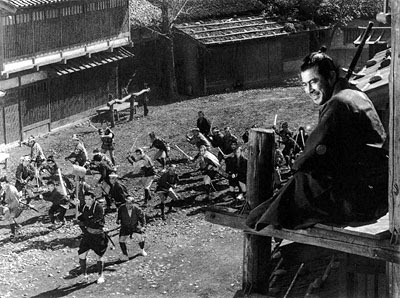
Yojimbo: Again, our ronin, Mifune, lands in a town populated by two rival gangster families. they take jabs at each other once in a while but nothing ever relly happens. sure, three or four are killed each day but nothing major. Then Mifune comes along. he wants to con both families for money. he shows the families that he can kill about every living thing in sight. now they fight for him exactly as planned. each one offers ore and more. he accepts, takes the money sometimes and then goes to the other family. his ulitimate plan though, is a good deed. both families are, for lack of a better word, "bad-guys". by wiping both out he can douse the crime in the country. he will not kill all of them by himself, he will set them against each other so they wil kill themselves. there is much lying and conning in the film which shows Kurosawa's own wit and cleaverness. this is an exquisite ride. a thrill and masterpeice of the 60's. this film was remade in Sergio Leone's spaghetti western called "A Fist Full of Dollars" from 1964 which was another great film. this shows Kurosawa's versatility. his films touch certain subjects that can be used in any form or and setting in the world. My grandfather made an interesting but obvious observation about the film: it's like a John Ford film where John Wayne is the expirienced, burnt-out, wise character helping the naive get what was theirs. he is absolutly correct. Ford was Kurosawa's idol and is in about every one of his shots. There is also a good deal of comedy such as Inokichi, Ushitora's (one of the family's leader) rotund brother who just looks like a bufoon. Yojimbo means bodyguard in which Mifune was hired as many times. The score by Masaru Satô has such a unique sound ofr the early 60's and i really have not heard anything like it. we can see many correlations between this and Ang Lee's masterpeice "Wo Hu Cang Long".

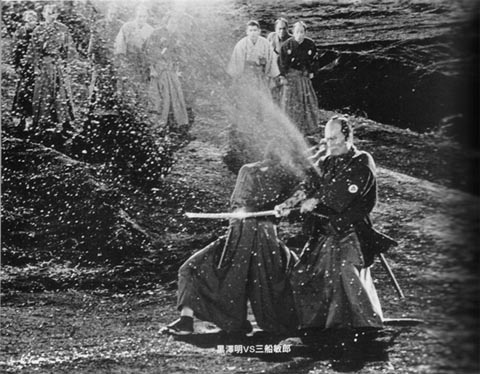
Sanjuro: Some believe that this is the weaker of the two but like the Kill Bill series, one can't be better than the other because it's a continuation! one can't do without the other. i think both are expertly written, masterfully acted and of course gorgeously shot. So our ronin comes upon a bunch of youngsters devising a plan to rescue their framed uncle. of course Mifune sees a billion hole through their plan and decides, after correcting them a few times, to help. the corrupt superintendent holding the uncle has the army and the fortress but his advisors are not exactly deft at what they do. So we have our sly samurai and a handfull of good-hearted and fiery worriors and you have yourself a picture. Mifune goes up to the superintendent and shows his skills and the superintendent takes him on as a bodyguard; another way to get in. The women often play that role of the weak and non-violent which changed quite a bit in the years to come. Like "Yojimbo" there is much trickery and Mifune lies through his teeth but makes everything sound convincing. This makes him a better hero than batman. I love the films smartness. it really makes the film what it is. the climax is something out of a Tarantino film. i remember the first time i saw the film, it was late and by the end, i was beginning to fall asleep, the climax woke me up. This is what Tarantino revolve around, this style of fimmaking. the raunchy, kick-ass characters with stern voices. the spraying blood effect which is unrealistic but gives the neccesary effect.

Both films are masterpeices. all Kurosawa's are. i love his style, smarts and everything else. The films shocking violence and disturbing images mst have been quite a surprise and it would have been interesting to see the reaction. Probably like that of "Bonnie and Clyde" in 1967. i feel so inspired after watching a Kuroswa. if you notice, Mifune's character in both films is very much like that of a dog. the way he scratches himself looks at others and ponders on their faces. i love little nuances such as those. these films should be cherished forever. it is a lost art that Criterion Collection continues to preserve.

 "Yojimbo" Academy Award:
Academy Awards, USA
YearResultAwardCategory/Recipient(s)
1962 NominatedOscarBest Costume Design, Black-and-White
Yoshirô Muraki